Types of Scrubs: How Modern Styles Balance Personal Style and Professional Needs
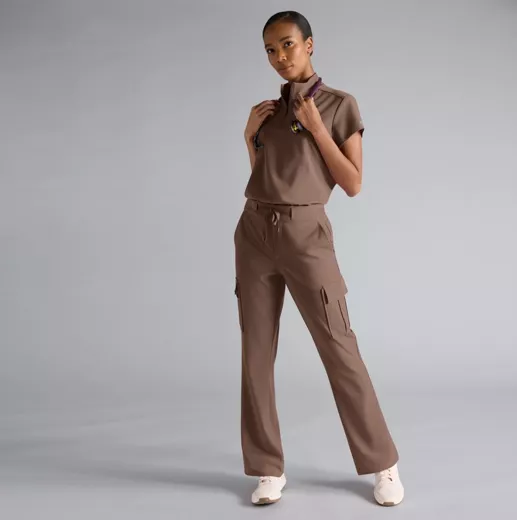
Brown stand-collar zip scrub top and cargo scrub pants, shown full length
What are the main types of scrubs?
Scrubs divide first into tops and bottoms, then into cuts within each. Tops are sold by neckline — Collar, Crew, V-Neck and Y-Neck. Pants are sold by leg shape — Boot Cut, Flare Leg, Jogger, Straight, Tapered and Wide in women’s, with Cargo in place of Flare and Wide in men’s. Both come in multiple fits and waist treatments.
Three things to take away
• Neckline and leg shape are the two decisions that change how a set works, not just how it looks.
• Style and function are no longer a trade-off — the practical details are designed in alongside the silhouette.
• Your unit’s dress code narrows the field before preference does. Check it first.
How have scrub styles changed?
Scrubs replaced the white dress and cap because they were easier to wash, easier to move in and easier to standardize across a department. Color arrived when departments grew and patients needed a faster way to tell an RN from a surgical tech. Cut came last — and that is where most of the choice now sits.
Material came next. Healthcare apparel now includes organic cotton, recycled polyester and bamboo-derived fibers as well as conventional fabrics. What scrubs are made of is now a purchasing consideration in itself. It is a different question from how they are cut, and different again from how they are cared for.
The range widened at the same time. Size ranges extended, gender-specific and gender-neutral cuts started appearing side by side, and the number of separate fit decisions grew well beyond what one base pattern could offer. Our own category filters show where that landed: in women’s scrub pants, size is one of five separate choices, not the whole decision.
Personalization is part of it too. Embroidered logos, monograms and custom patches are widely available. They do double duty — a department gets consistent identification, and the wearer gets something that reads as theirs rather than as issued kit.
Scrub tops: necklines and cuts
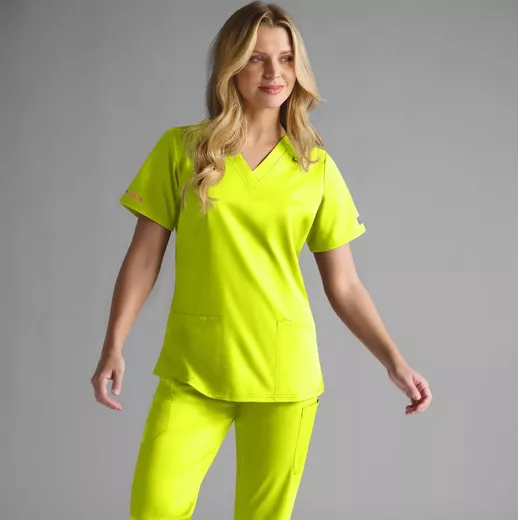
Lime green V-neck scrub top with two lower pockets
Four necklines run across our women’s and men’s tops.
• V-Neck. The most widely stocked option. The open neckline sits clear of a stethoscope.
• Crew. More coverage at the chest and a closer collar. It covers more than a V-Neck, so check it against your layering habits.
• Y-Neck. A Y-shaped opening — a middle ground between the coverage of a Crew and the openness of a V-Neck.
• Collar. The most structured look, common where a department wants a step up from standard scrubs. Check shoulder mobility.
Those four are the values in our neckline filter. Individual product names go further than the filter does — the range also includes mock wrap, henley, sweetheart, split neck, round neck, mandarin collar, crisscross and a stand collar with a half zip. If you filter by neckline alone you will not see them, so it is worth reading product names too.
Neckline aside, tops are also sold as tuck-in styles, with a shorter hem designed to tuck, and dolman sleeve styles, with a wider armhole. Beyond the cut, side vents add movement at the hip without losing coverage, and a badge loop keeps ID from swinging. Pocket depth matters more than pocket count — a shallow chest pocket loses pens.
Solid, print or underscrub?
Our scrub top category splits three ways before you reach neckline at all.
• Solid tops. One color throughout. This is what most dress codes assume, and what a mandated shade usually means.
• Print tops. Patterned. Useful where a code allows pattern.
• Underscrubs. Long-sleeve knit layers designed to go under a scrub top rather than replace it. A separate garment, not a neckline choice.
Underscrubs are easy to overlook if you browse by neckline. If your unit runs cold, or your code prohibits bare arms, the layer underneath is the decision — not a different scrub top.
Sleeve length and layers
Sleeve length is not one of our filters, so it appears in product names. The range includes short sleeve, three-quarter sleeve, long sleeve and dolman sleeve tops, plus short-sleeve scrub hoodies and knit pullovers.
Two practical notes. Scrub tops are stocked in Regular length only — Petite and Tall apply to pants, not tops, so a length problem in a top is a size or fit question instead. And if you layer, check the sleeve of the underscrub against the sleeve of the top, because a long knit cuff under a short sleeve is easy to miss until you are wearing both.
Scrub pants: leg shapes, waists and fits
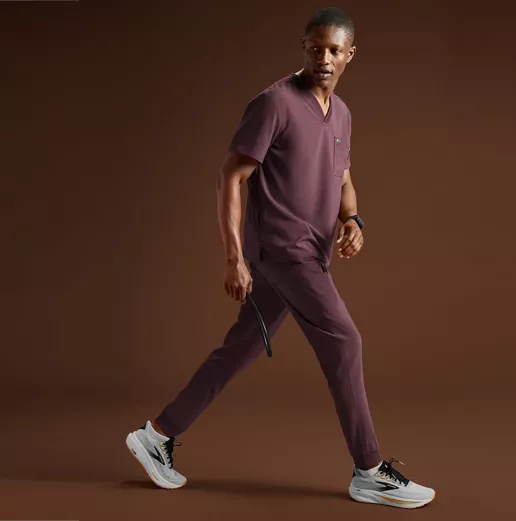
Wine jogger scrub pants with cuffed ankles, worn with a V-neck scrub top
Pants divide first by leg shape. Not every shape appears in both ranges.
• Jogger. A tapered ankle keeps the leg opening off the floor without hemming.
• Straight. The most versatile shape and the easiest to get right on length.
• Tapered. Narrows through the lower leg without closing at the ankle.
• Wide. More room through the leg. Check hem length and floor clearance carefully.
• Flare Leg. Shaped through the lower leg. Same length check as Wide, and worth confirming against your dress code.
• Boot Cut. A slight opening at the hem, cut to sit over a shoe.
• Cargo. More pocket capacity for roles that carry more. Check where the weight sits when the pockets are full.
Waist is its own decision. The women’s range offers Button/Snap Closure, Drawstring, Drawstring/Elastic, Elastic Waist, Flat Front, High Waisted, Yoga and Zip Fly; men’s offers fewer. A higher waist covers the lower back through a squat; a yoga or elastic waist gives more at the hip.
Fit is a fourth decision: Athletic, Classic, Contemporary, Maternity and Modern are all offered in both tops and pants. Flare Leg and Wide appear in women’s pants; Cargo appears in men’s.
Which scrub style may suit which preference?
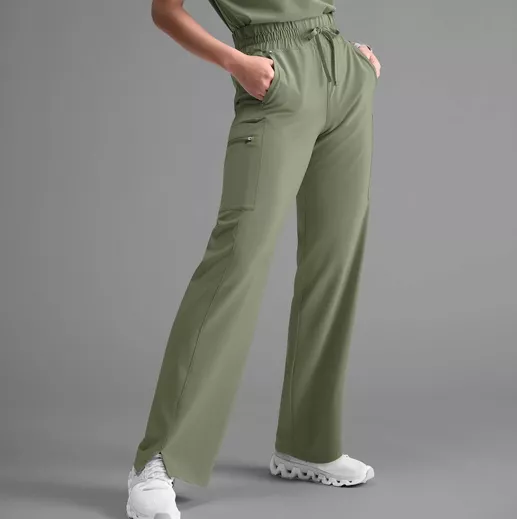
Olive wide-leg scrub pants with a drawstring waist and a zip cargo pocket
Use this quick reference before you order. Each entry names a style, the preference it may suit, and the one thing worth checking before you commit to it.
Pants
• Jogger. May suit a wearer who prefers a tapered, athletic line. Check ankle coverage, waistband and dress code.
• Straight. May suit a wearer who prefers a versatile, classic shape. Check length and waist treatment.
• Tapered. May suit a wearer who prefers a narrower lower leg with an open hem. Check hem position when seated.
• Wide. May suit a wearer who prefers more room through the leg. Check hem length and floor clearance.
• Flare Leg. May suit a wearer who prefers a shaped, contemporary silhouette. Check correct length and workplace suitability.
• Boot Cut. May suit a wearer who prefers a hem that sits over the shoe. Check length with your actual work shoes.
• Cargo. May suit a wearer who carries more on shift. Check where the weight sits when the pockets are loaded.
Tops
• V-Neck. May suit a wearer who prefers a cooler, open neckline. Check coverage when bending.
• Crew. May suit a wearer who prefers more neckline coverage. Check layering and warmth.
• Y-Neck. May suit a wearer who prefers a middle ground on coverage. Check how it sits under a stethoscope.
• Collar. May suit a wearer who prefers a structured look. Check department standards and shoulder mobility.
Which professional needs must modern scrubs still meet?
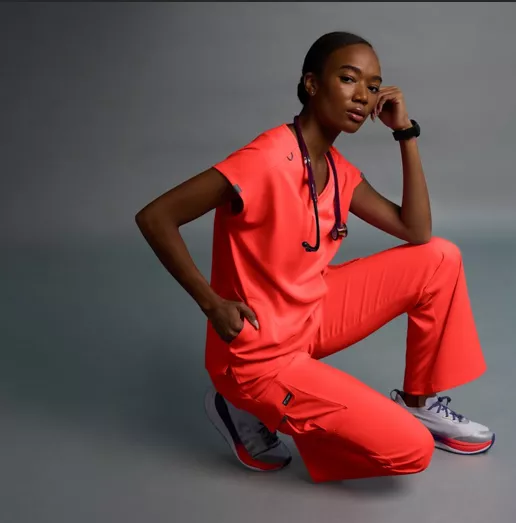
Coral V-neck scrub top and cargo scrub pants worn while kneeling
Whatever the cut, the requirements are the same. You need mobility through reaching, bending and kneeling, and coverage that holds when you move rather than only when you stand. You need pocket access you can use one-handed, a waistband that stays put without a hand on it, and a hem that clears the floor. And you need care requirements you will actually follow, inside whatever your unit’s color and identification rules allow.
What’s one way modern scrub styles are evolving to reflect nurses’ personal style and professional needs?
The clearest shift is that style and function have stopped being a trade-off. A nurse choosing joggers, a wide-leg pant or a crew-neck top no longer has to give up pocket capacity, coverage or a secure waistband to get the look they want. Those details are now designed in alongside the silhouette. The useful test is still the shift itself: movement, storage, coverage, care and the unit’s dress code.
Personal expression inside a dress code
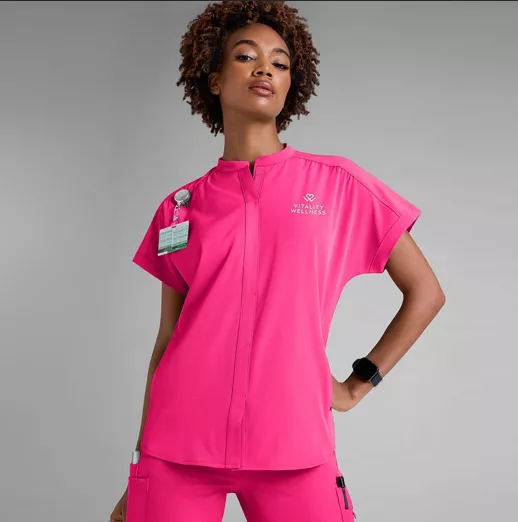
Pink stand-collar scrub top with an embroidered logo and a photo ID on a badge reel
If your facility requires a specific shade, check a swatch against your existing sets before you reorder. The same color name can read differently across fabric weights, weaves and dye lots.
Accessories are usually where there is room — patterned compression socks, a badge reel — and they are the easiest thing to check against your code. Approved embroidery is another route. Coordinated sets take the matching decision away, and deliberate mismatching is its own approach.