



How Should Scrubs Fit? A Guide to Size, Rise, Inseam and Proportion
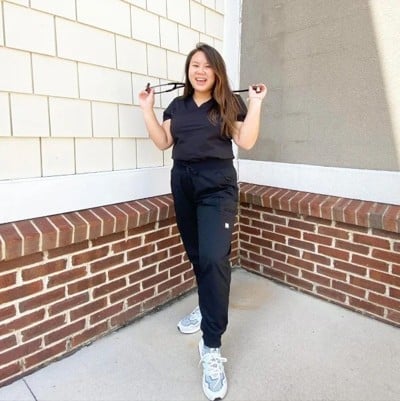
Black scrub top and matching jogger scrub pants seen full length, the cuffed hem sitting clear of the shoe
How should scrubs fit?
Scrubs should sit close enough to move safely and loosely enough to bend, reach and kneel without pulling. Shoulder seams should land on the outer edge of your shoulder. The top should stay put when you raise both arms, and the pant hem should clear the floor in your work shoes. Labeled size is only one of several fit decisions.
Three things to take away
• Size is one variable. Length, leg shape, waist and fit are separate decisions.
• Two garments in the same labeled size can fit and function very differently.
• Most fit failures show up in movement, not in the mirror. Test before the return window closes.
Why labeled size is only one fit decision
Ask healthcare professionals how scrubs should fit, and most will answer with a size.
Our own catalog is organized the opposite way. In women’s scrub pants, size is only one of five independent choices:
• Size — an extended range running from XXS through plus sizes
• Length — Regular, Petite and Tall
• Leg shape — Boot Cut, Flare Leg, Jogger, Straight, Tapered and Wide
• Waist treatment — from drawstring to high-waisted to yoga
• Fit — Athletic, Classic, Contemporary, Maternity and Modern
Those are not variations on a size. They are separate decisions, and that is why two garments with the same number on the label can fit and work very differently. Extending a size range on its own does not solve fit.
Fit also has to work in motion. A clinical floor is dense with IV poles, bed rails, cart handles and monitor cables, and surplus fabric is one more thing hanging off you. Functional fit means enough room to work and no more cloth than the job needs.
How should a scrub top fit?
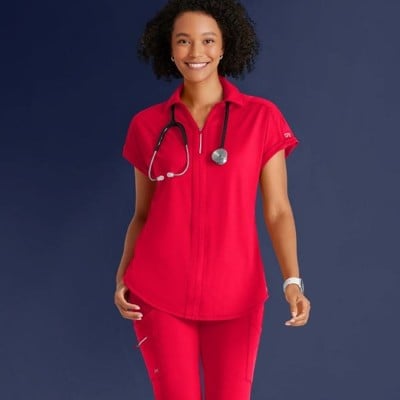
Red collared scrub top with a zip front, its curved hem falling below the hip over scrub pants
Start at the shoulder, because it is the one point that is not practical to alter later.
The shoulder seam test. The seam joining sleeve to body should land on the outer edge of your shoulder, where the bone breaks toward your arm. A seam sitting inside that point drags the sleeve down every time you reach overhead. A seam hanging past it drops the whole armhole, which limits how high you can lift before the top pulls across your back.
Check the chest at full extension. Cross your arms, then press down as if starting compressions. Fabric should stretch, not strain. Horizontal pull lines radiating from a placket or neckline mean the top is restricting you at exactly the moment you need range.
Neckline is a coverage decision, not just a style one. Across our women’s and men’s tops the necklines are Collar, Crew, V-Neck and Y-Neck. A V-Neck sits clear of a stethoscope. A Crew gives more chest coverage. A Collar reads more structured. Check each against how far you bend.
Length settles the tuck debate, and it is where proportion shows. A top ending at mid-hip looks intentional untucked and keeps airflow at the waist. Anything longer can look unfinished untucked and bunch under a waistband when tucked. Tuck if your dress code says so; otherwise pick the hem length that works untucked.
How should scrub pants fit?
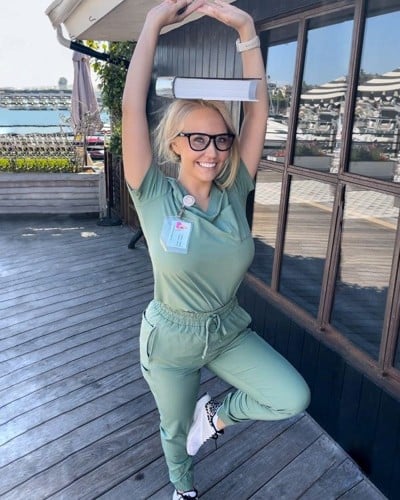
Sage green jogger scrub pants with a drawstring waist and elasticated ankle cuffs, worn with a matching top
Inseam is the measurement most people never check, and the one that shows first.
Set the hem by your shoes, not the tag. The hem should clear the floor when you are standing in the shoes you actually work in. A hem that drags gets underfoot and is the first thing to look untidy.
Match the length category to your height. Regular, Petite and Tall exist because the same labeled waist has to serve very different leg lengths. All three are available within our plus-size range as well, not only in the core sizes. Measure from crotch seam to your intended hem while wearing your work shoes.
Choose the waist and rise for the tasks you actually do. Rise is the distance from the crotch seam to the top of the waistband — it decides where the pant sits on you, and it is a separate decision from size. Waist treatment is its own filter for a reason: drawstring, elastic, drawstring-and-elastic, flat front, zip fly, button or snap, yoga and high-waisted are all offered. A higher rise, such as a high-waisted style, keeps the lower back covered when you squat to a floor-level line or lean over a bed rail. A lower rise may suit someone who finds a high waistband restrictive at the hip.
Leg shape changes more than the look. A jogger closes the hem at the ankle, which keeps the leg opening off the floor without hemming. A wide or flare leg needs a more careful length check. Tapered and straight are the most forgiving on hem position.
Do not solve a long inseam by rolling the cuff. A rolled hem loosens through a shift and comes undone when you least want to deal with it.
Should scrubs be tight or loose?

Purple scrub top skimming the hip over jogger scrub pants that taper to the ankle
The question new grads ask most often is how tight scrubs should be — usually after a preceptor commented on a set that fit fine at home.
Too loose. Wide legs and a boxy top can be awkward in busy work. Surplus fabric can catch on bed rails and cart corners, sleeves can drop into places you would rather keep clean, and a drawstring waist that slides down mid-shift means adjusting your clothes with hands that just finished a task.
Too tight. Restriction is the bigger problem. If a top limits how far you can raise your arms, or a pant seam pulls when you kneel, you are changing how you move to accommodate your clothing. That is the wrong trade every time.
The workable standard is the two-inch pinch. At the chest, the hip and the thigh, you should be able to gather roughly two inches of fabric between your fingers. Less than that is restriction. Much more is excess.
How do you size scrubs to your measurements?
Measure first. Guessing is what drives returns.
• Chest or bust. Tape around the fullest point, level front to back, over light undergarments only.
• Natural waist. The narrowest point of your torso, usually just above the navel. Snug, not compressed.
• Hip. The fullest part, feet together.
• Inseam. Crotch seam to hem, in your work shoes.
Read the size chart by measurement, not by the size you wore last. Chest, waist and hip are the three that pick your labeled size; inseam picks the length category. Compare all four to the chart and note where they land.
If your hip reads one size and your waist another, size to the larger measurement. Then look for a waist treatment that takes up the difference — a drawstring or elastic waist does this better than a flat front. If your numbers put you squarely at the top of a range, stay with the larger size. Fit also varies by brand and collection, so check the chart for the specific style rather than assuming your size carries across.
What is one way the traditional scrub market can adequately serve the diversity of today’s nursing workforce?
One meaningful step is to move from a single base pattern to a genuine fit system. The US nursing workforce has a median age of 50 and is becoming more racially diverse, according to NCSBN’s 2024 survey of 744,714 registered nurses. But the simpler point is that bodies and jobs vary. Offering multiple lengths, leg shapes, waist treatments and fits gives more people a workable choice than extending one pattern’s size range.
Where the range still has gaps
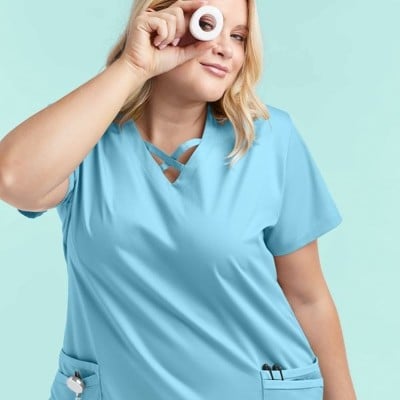
Light blue scrub top with a crossover V-neckline and cargo pockets at the hip
An honest fit system means naming what is missing, too.
Plus size is well covered on length, with Regular, Petite and Tall all available inside it. Maternity Scrubs is the thinnest category by a wide margin, in both the number of styles and the choice of leg shapes, and it does not reach as far up the size range as plus size does. A customer who needs maternity at the top of the size range has no option there.
Men’s and women’s ranges are also not symmetrical. Flare Leg and Wide appear in women’s pants but not in men’s. Cargo appears as a leg shape in men’s, while in women’s it sits in a category of its own. Flat Front and Yoga waists appear in women’s but not in men’s.
Those are the honest edges of the system. Availability changes, and not every option appears in every style, color or size, so check the specific product.
The five-check scrub fit checklist
Run these five checks on every scrub set before the return window closes.
1. The hem clears the floor — standing, in your work shoes.
2. Shoulder seams sit on the natural shoulder break — raise both arms overhead. If the top pulls across your back or the hem lifts above your waistband, the armhole is set wrong for you.
3. Two inches of fabric pinch at chest, hip and thigh — less is restriction, considerably more is excess.
4. A higher waist covers the lower back through a full squat — if your role involves frequent bending, kneeling or floor-level work, test it in a mirror.
5. The waistband holds without a hand on it — walk, sit, stand and bend. A waistband that migrates during that sequence will migrate all shift.
Failing any one of these is a sizing problem, not a body problem. Exchange the garment and note what you learned for the next order.
What to do if a set already does not fit
Most fit advice assumes you have not bought yet. If the set is already in your locker, the useful question is which problem you have, because some are fixable and some are not.
• It rides up when you reach. The armhole is set too low for you. Not practically fixable — exchange it, and check the shoulder seam next time before anything else.
• It bunches at the waist when tucked. The top is too long to tuck. Either wear it out, or move to a tuck-in style, which is cut shorter for the purpose.
• The waistband slides down through the shift. Either the waist is too large, or the treatment is wrong for how you move. A drawstring or elastic waist holds where a flat front will not.
• The hem drags. Wrong length category rather than wrong size. Check Petite, Regular and Tall before you size down, because sizing down to fix a hem usually creates a waist problem.
• It pulls across the back when you lift. Too tight through the shoulders, whatever the label says. Size up rather than stretching it out.
• A pocket loses pens. Pocket depth, not pocket count. Nothing fixes it except a different garment.
The pattern worth noticing: a length problem and a size problem look similar in the mirror and are not the same fix. Sizing up to solve a hem, or down to solve a drag, is how people end up with two things wrong instead of one.
Common questions about scrub fit
Do scrubs run big or small?
There is no single answer, because fit varies by brand and collection, and two scrub sets with the same labeled size can fit very differently. Check the size chart for the specific style against your chest, waist and hip measurements rather than assuming the size you wore last will carry across.
Should I size up or down in scrubs?
If your measurements fall between sizes, size to the larger one, then choose a drawstring or elastic waist to take up the difference. If your numbers sit at the top of a size range, stay with the larger size. Do not size down to fix a long hem: change the length category instead, because sizing down to fix a hem usually creates a waist problem.
How long should scrub pants be?
Scrub pant hems should clear the floor while you stand in the shoes you actually work in. If the hem drags, change the length category — Petite, Regular or Tall — rather than the size, and measure your inseam from the crotch seam to the hem in your work shoes. Rolling the cuff is not a fix, because a rolled hem loosens through a shift.
How can I tell if my scrubs fit properly?
Run five checks before the return window closes. The hem clears the floor in your work shoes. The shoulder seams sit on the natural shoulder break when you raise both arms. You can pinch about two inches of fabric at the chest, hip and thigh. If your work involves frequent bending or kneeling, a higher waist covers your lower back through a full squat. And the waistband holds without a hand on it while you walk, sit, stand and bend.
Why do my scrub pants keep falling down?
Scrub pants that slide down through a shift usually have one of two problems: the waist is too large, or the waist treatment is wrong for how you move. A drawstring or elastic waist can hold where a flat front does not. Test a new pair by walking, sitting, standing and bending without a hand on the waistband.
Why does my scrub top ride up when I reach?
A scrub top that rides up when you reach usually has an armhole set too low for you, often because the shoulder seam hangs past the edge of your shoulder. That is not practically fixable, so exchange the top. Next time, check that the shoulder seam lands on the outer edge of your shoulder before you check anything else.
What sizes do scrub pants come in?
Uniform Advantage’s women’s scrub pants run from XXS through plus sizes, in three lengths: Regular, Petite and Tall. Size and length are separate choices, alongside leg shape, waist treatment and fit. Not every option appears in every style, color or size, so check the specific product.
What to do next
Start with the sets you already own. Put each one on, run the five checks above, and keep the ones that pass.
For anything that fails, note which check it failed. That is the thing to change on your next order — the size, the length category, the waist treatment or the leg shape. Then measure yourself properly and order from the size chart rather than from memory.